


Serbian Present Tense: The “Magic” Tense
Did you know that in Serbian, you only need to learn one present tense? In English, you have to at least choose between “I eat” and “I am eating.” In Serbian, it’s just one word: Jedem.
Here are some of the most common and the easiest way to use Serbian Present Tense:
1.What’s Happening Right Now
Use this when you are in the middle of an action – the action is happening at the same time when we are saying it:
- Sedim i čitam knjigu. (I am sitting and reading a book.)
- Šta radiš? (What are you doing?)
- Spremam materijale za sutrašnji čas. (I prepare material for tomorrow’s lesson.)
2. Habits and Facts
Use this for things that are always true or happen often.
- Sava se uliva u Dunav. (The Sava river flows into the Danube.)
- Mika često ide u bioskop. (Mika often goes to the movies.)
- Ljudi se više šetaju kada je napolju toplo. (People walk more when it is warmer outside.)
3. The “Near Future”
If something is definitely happening soon (like tomorrow), you don’t need a complicated future tense. Just use the present! If you happen to be familiar with the verbal aspect, the imperfective one will be used here.
- Sutra je subota. (Tomorrow is Saturday.)
- Večeras idemo na kafu. (Tonight we are going for a coffee.)
- Kupujemo novi stan. (We are buying a new apartment.)
4. Some situations with using “DA” (The Connector)
This is a Serbian “superpower”. We use the present tense after the word da to show why we are doing something (it can be replaced with more formal “in order to”) or when we use is with the modal verbs like moći, želeti, hteti, smeti, voleti, trebati:
- Uzeo je taksi da stigne na vreme. (He took a taxi to arrive on time.)
- Želim/moram/hoću/treba/smem/mogu da plivam. (I want/have to/want/need/am allowed/able to to swim.)
- Idem da spavam. (I go to sleep.)
Why The Present Form Matters in Serbian
My students often ask me why do they need to know all these forms and is it enough to say the pronoun. In Serbian, actually, you are going to hear sentences without pronouns much more often than the sentences with them. For example, “Čitam” is much more often than “Ja čitam”. We are going to use pronouns only if we have to – if the context asks us to.
The Forms of The Serbian Present Tense
Serbian Present Tense is made of one word only: radim, učiš, volite, slušaju, putuje, čitamo etc. Every verb is going to have six different forms, for six different persons (ja, ti, on, mi, vi, oni). The endings has been added to the base that is named “prezentska osnova(present stem)”, which we get when we get rid of the ending… bit confusing, right?
This is why I tell my students: When you are learning the new verb, you need to learn both: infinitive (which you can can find in the dictionaries) and the present form. Sometimes present forms will be very easy to guess, but sometimes they will be with differences which you couldn’t foreseen. Here are the examples:
| infinitive | present stem | translation |
| raditi | radi- | to work |
| voleti | voli- | to like, to love |
| početi | počne- | to start |
| čitati | čita- | to read |
| putovati | putuje- | to travel |
| kupovati | kupuje- | to buy |
| slušati | sluša | to listen |
| doći | dođe- | to come |
| ići | ide- | to go |
As you can see, one person means one ending. The table with endings, added to the “present stem” looks like this:
| JA | –M |
| TI | -Š |
| ON, ONA, ONO | NO ENDING! |
| MI | -MO |
| VI | -TE |
| ONI, ONE, ONA | -E/-U/-JU |
Demisitification of The Third Person Plural Form
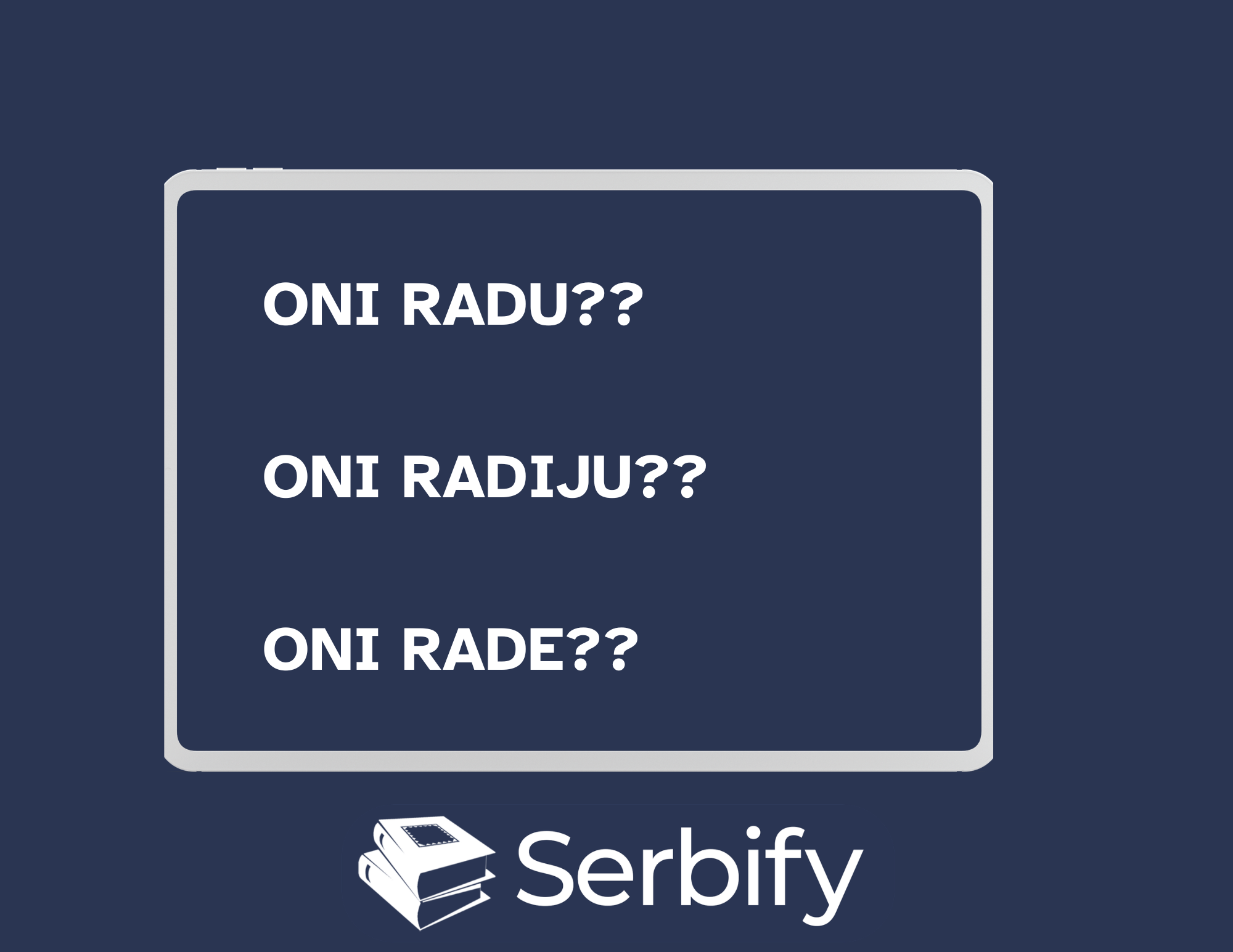
So, the vast mayority of the verbs is going to have these, above listed endings. They are pretty regular in all the persons, except in the third person plural. How do we know which of these three endings in plural is going to be used? T
he answer is very easy: we need to know which vowel precedes to the listed ending.
I have illustrated it with these tables below, but here you have one general table for all of them:
| Group | Vowel | 1st person singular | 3rd person plural |
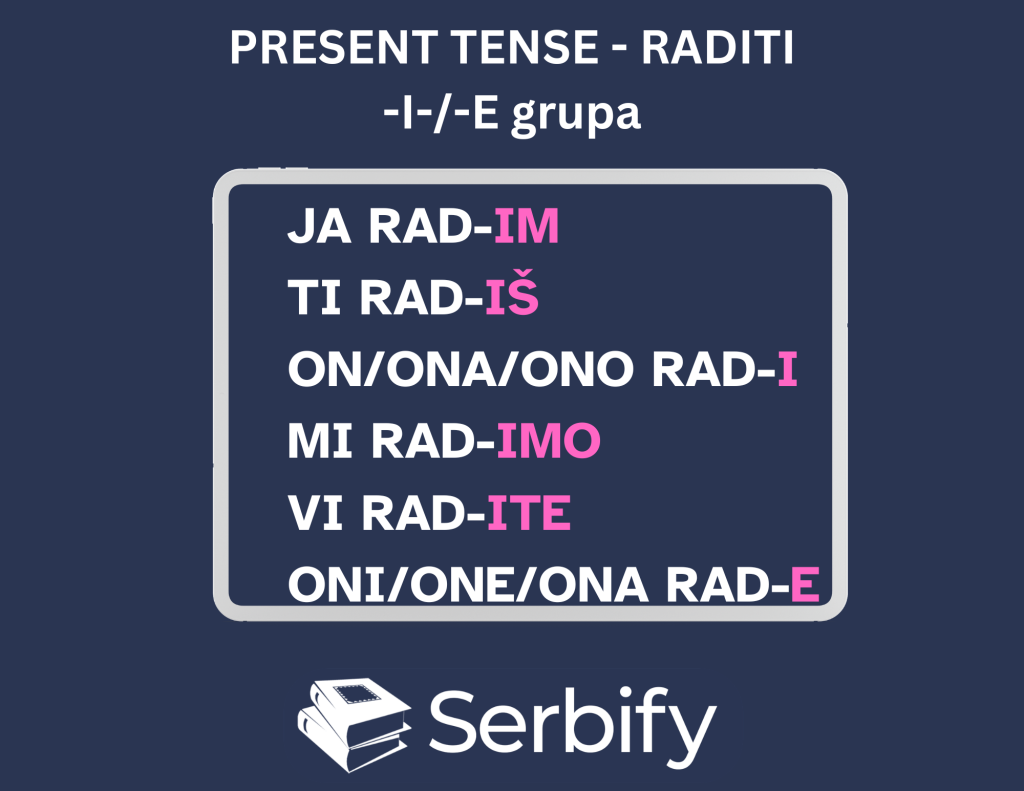
| I | -I- | volim, radim | vole, rade |
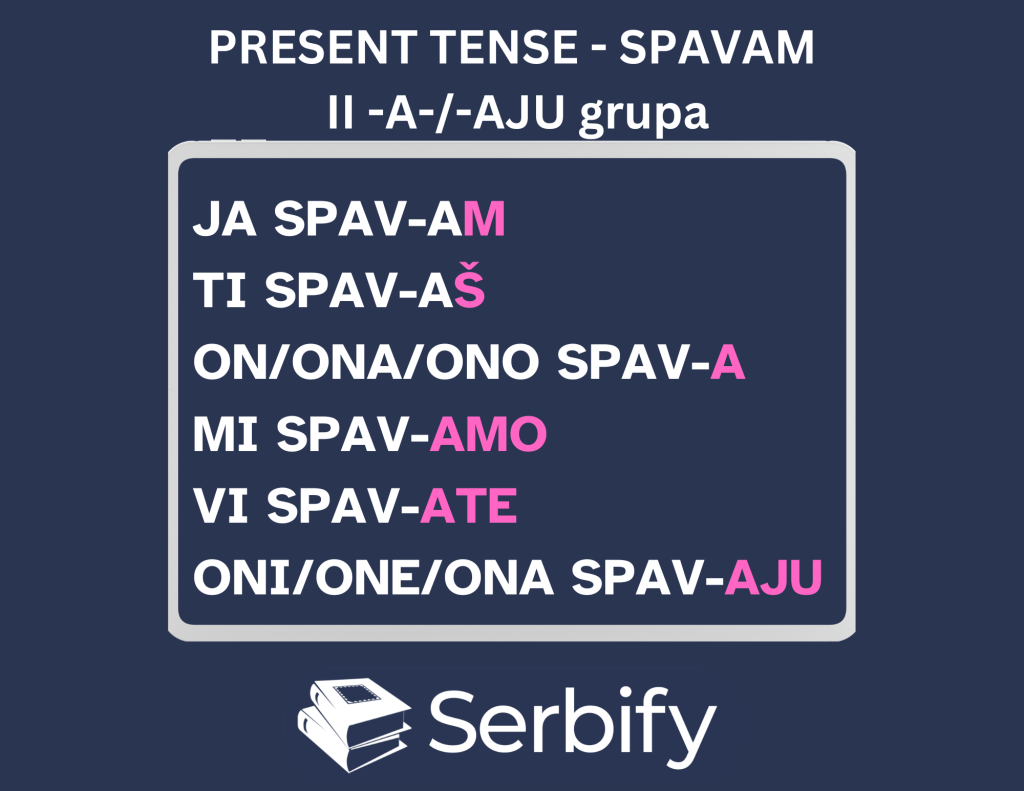
| II | -A- | čitam, pevam | čitaju, pevaju |
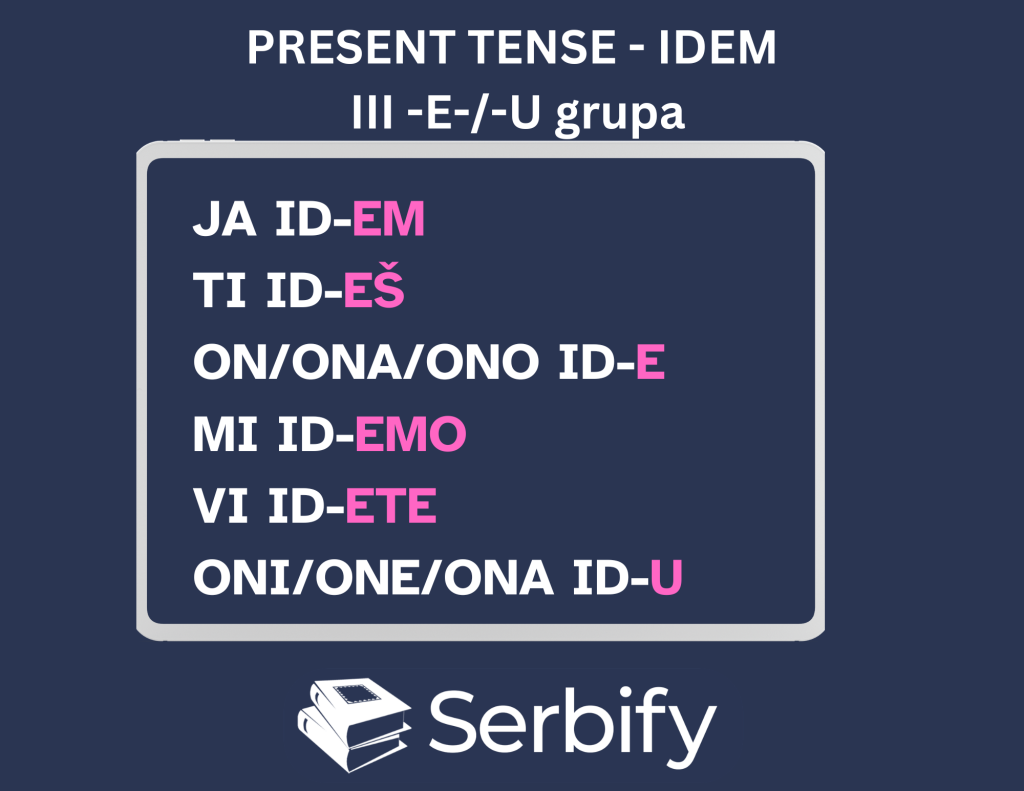
| III | -E- | putujem, idem | putuju, idu |
So, if the vowel that precedes is –I-, we will have –E in the thirs person plural:
If the vowel that precedes is –A-, we are going to have –JU as an ending:
If the vowel that precedes is –E-, we are going to have –U as an ending:
How to Build Negative Present Form in Serbian
It’s simple: we add NE to the basic form.:
Ja ne radim. Mi ne radimo.
Ti ne radiš Vi ne radite.
On/ona/ono ne radi. Oni/one/ona ne rade.
There will be only three verbs when NE and the basic present form will be written together:
BITI/JESAM: JA NISAM, TI NISI, ON(ONA, ONO) NIJE, MI NISMO, VI NISTE, ONI(ONE, ONA) NISU
IMATI: JA NEMAM, TI NEMAŠ, ON(ONA, ONO) NEMA, MI NEMAMO, VI NEMATE, ONI (ONE, ONA) NEMAJU;
HTETI: JA NEĆU, TI NEĆEŠ, ONA(ONA, ONO) NEĆE; MI NEĆEMO, VI NEĆETE, ONI(ONE, ONA) NEĆE.
Exceptions in using The Serbian Present Tense
Here is the fact: We have really very, very few exceptions here. The most famous are the modal verbs MOĆI i HTETI. Here is how they look:
MOĆI
Ja mogu. Mi možemo.
Ti možeš. Vi možete.
On, ona, ono može. Oni, one, ona mogu.
HTETI
Ja hoću. Mi hoćemo.
Ti hoćeš. Vi hoćete.
On, ona, ono hoće. Oni, one, ona hoće.
Several verbs are going to be irregular only in the third person plural forms. Let’s see the most common ones:
umeti – oni umeju; smeti – oni smeju; razumeti – oni razumeju; uspeti – oni uspeju;
Some Extra Tips How to Know the Present Tense if You Know The Infinitive Form:
If the verbs ends in -isati in infinitive, it will have -iše(m) ending in the present tense: pisati-pišem; rezervisati, rezervišem; tolerisati, tolerišem; disati, dišem;
If the verbs ends with -ovati, it will have -uje(m) ending: kupovati, kupujem; putovati, putujem; poštovati, poštujem; verovati, verujem.
Will Every Verb Have a Present Form in Serbian?
This is so interesting. In my knowledge, I found only one verb that nowadays does not use the present tense: REĆI (to say). We use it in the past tense with the forms rekao, rekla etc. but in the present forms it is so archaic and irregular.
For The Learner
Can you write one sentence about what you are doing right now using the rules above? Drop it in the comments and I’ll check your conjugation!
You need more help about Serbian Present Tense? Feel free to contact me.


0 Comments