


There are two ways of looking at these nouns:
- If we pay the most of the attention to the the wan nouns are formed, we can see that they are more like masculine than like feminine because they are ending in a consonant: ex. stvar, reč, ljubav, radost, žalost…
- If we pay the most attention to the adjectives that follow, without any doubt we will call them feminine: ex. nova stvar, lepa reč, velika ljubav, njena radost, njihova žalost;
| the adjective ending in -A | the noun ending in consonant: |
| lepa | noć |
| velika | ljubav |
| naša | vlast |
What makes these Serbian language nouns so beautiful when it comes to their meaning?
Maybe because they will cover all those abstract meanings that we used to learn when we started our discovery of the world or when we started with the first poetry reading or the words that we would connect to the mystical and abstract ideas? What comes to your mind when you hear the following: ljubav (love), noć (night), reč(word), moć (power), smrt (death), radost(joy), bolest(illness)? I invite you to really feel their meaning. Are all of these somehow connected to the deepest questions of the human nature? Not to omit stvar since there is nothing in the abstract world that was not the preceding of something concrete before?
Maybe their meaning can be a signal for you as well – to pay attention to the declination if you notice that the noun is very beautiful when it comes to their meaning.
What about adjectives that go with consonant ending feminine gender noun?
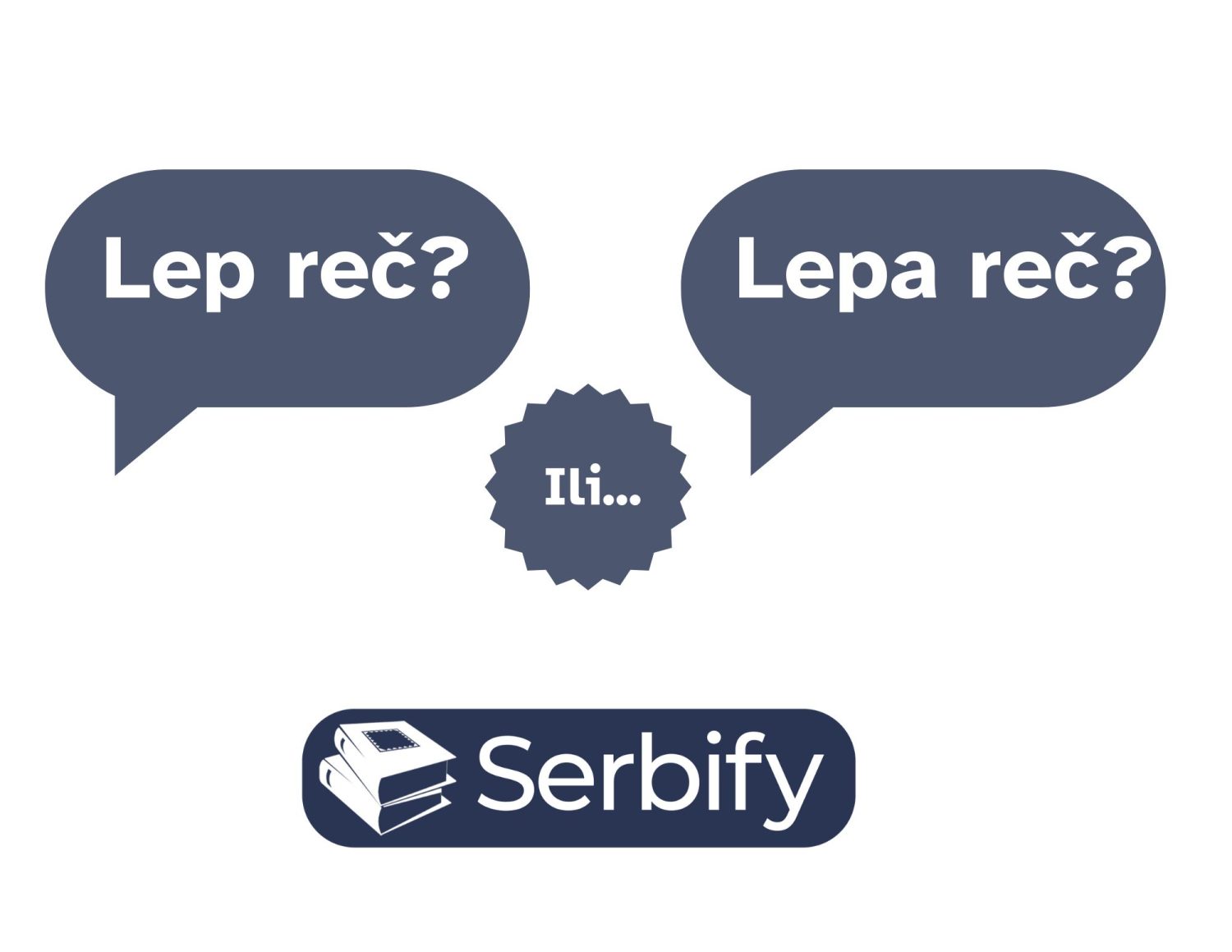
What is very important is that adjectives will follow usual, -A feminine nouns forms. It means that the same way we have “lepa kuća” declinated, we will have also “lepa reč”. Here comes the table for a clear illustration:
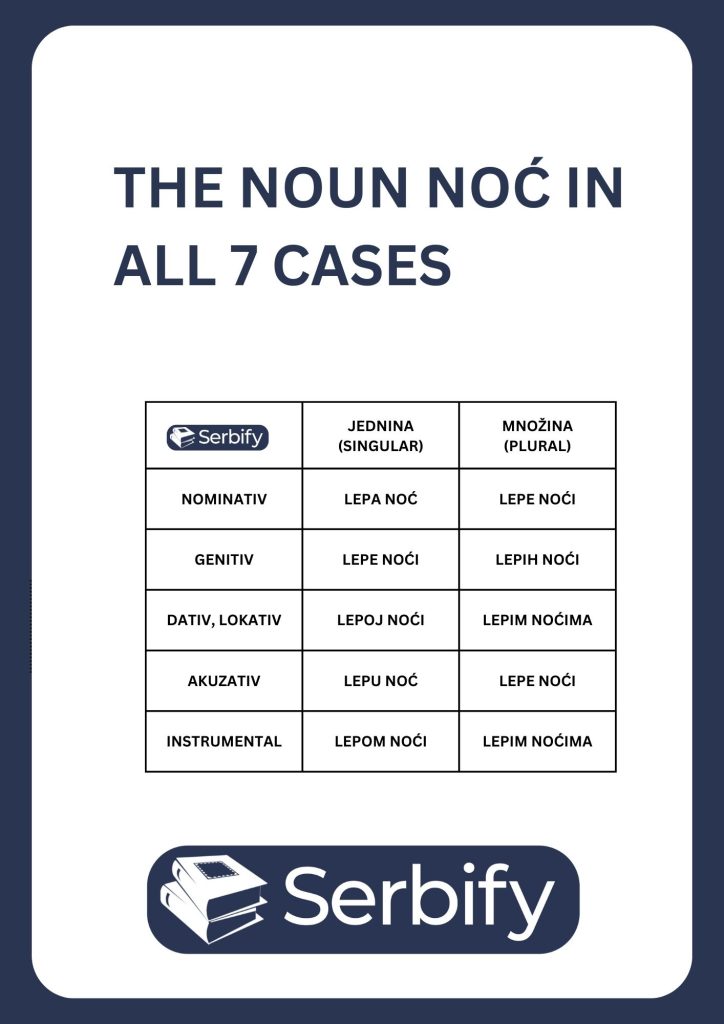
Why we call this Serbian language declention ,,I” declention?
When you look at the table given above, you can tell that there is one letter that is present in all the endings beside consonants’ ending – letter I. What is helping hand here is the fact that one can easily memorize case endings that are used here:
- Consonant ending: For nominative and accusative case in singular, we will typically have a consinant ending, as in noć, moć, reč, stvar;
- -IMA ending: This is the ending that is typical for dative, instrumental and locative case in plural: noćima, rečima, stvarima;
- -I ending: This is the ending that is typically used for all other cases, either singular or plural: noći, reči, stvari.
| ENDING | CASE |
| -CONSONANT | NOMINATIVE AND ACCUSATIVE SINGULAR (noć, reč) |
| -IMA | DATIVE, LOCATIVE AND INSTRUMENTAL PLURAL (noćima, rečima) |
| -I | ALL OTHER CASES IN SINGULARAL AND PLURAL (noći, reči) |
Instrumental case of I ending nouns: what is so special?
We can choose between two endings when it comes to instrumental case of this type of nouns: it can be either -I, as we mentioned above, but I have to warn you that it is also possible to hear this -ju ending: rečju, ljubavlju, mišlju, vlašću. They are not possible with every single I noun (*stvarju, *moću or *noću, for example, does not exist), but phonetic changes will be very interesting.
Why are the nouns SO and MISAO even more interesting?
We have this saying Nesreća nikad ne dolazi sama, or, speaking in English, that would be: When it rains, it pours. It can be very well used with words SO and MISAO where we are going to have additional phonetic changes that are complicating the situation even more: This is how they look like through various cases:
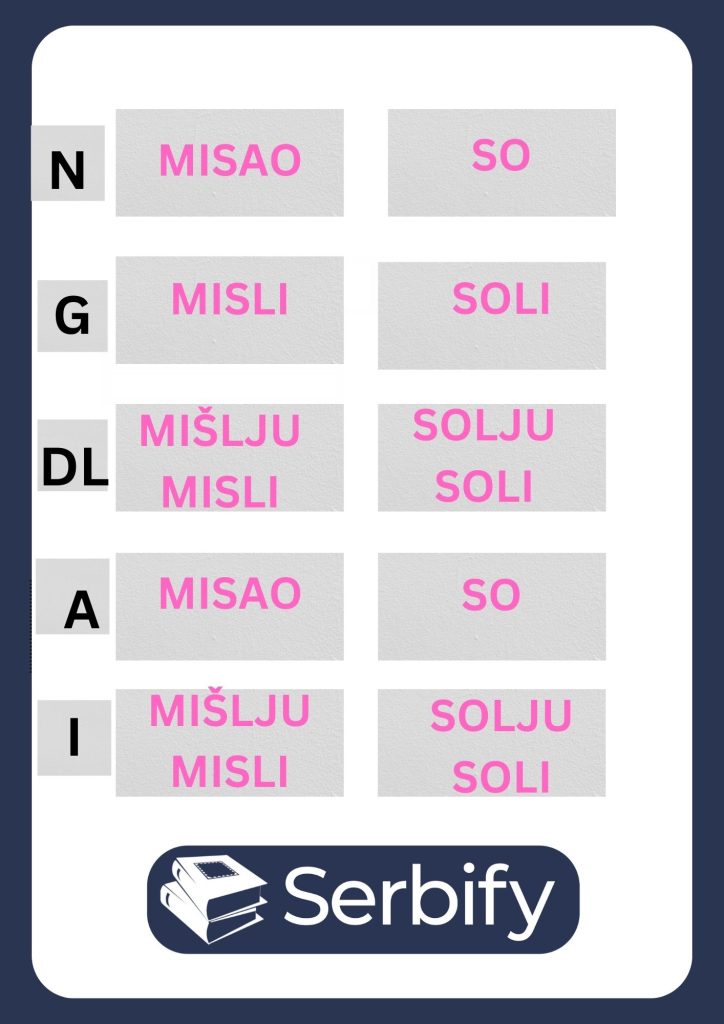
So, this nouns have phonetic change that turns L into O in the cases as nominative and accusative. In other cases, they will keep -L as the ending, so the general base for ,,misao” will be ,,misl-” and general form for so will be ,,sol”.
We should also pay attention to this specific ending in instrumental case: -JU, so when S gets close to J, it becomes Š: misl- + -ju: mišlju; And when L gets close to J it becomes LJ: sol- + -ju: solju.
How do the words oko i uvo belong to this group if they are neuter gender?
Words oko and uvo are very special because of the fact they will be neuter gender when they are in singular forms, but when they are used in plural, they will be in feminine gender and belong to I declination.
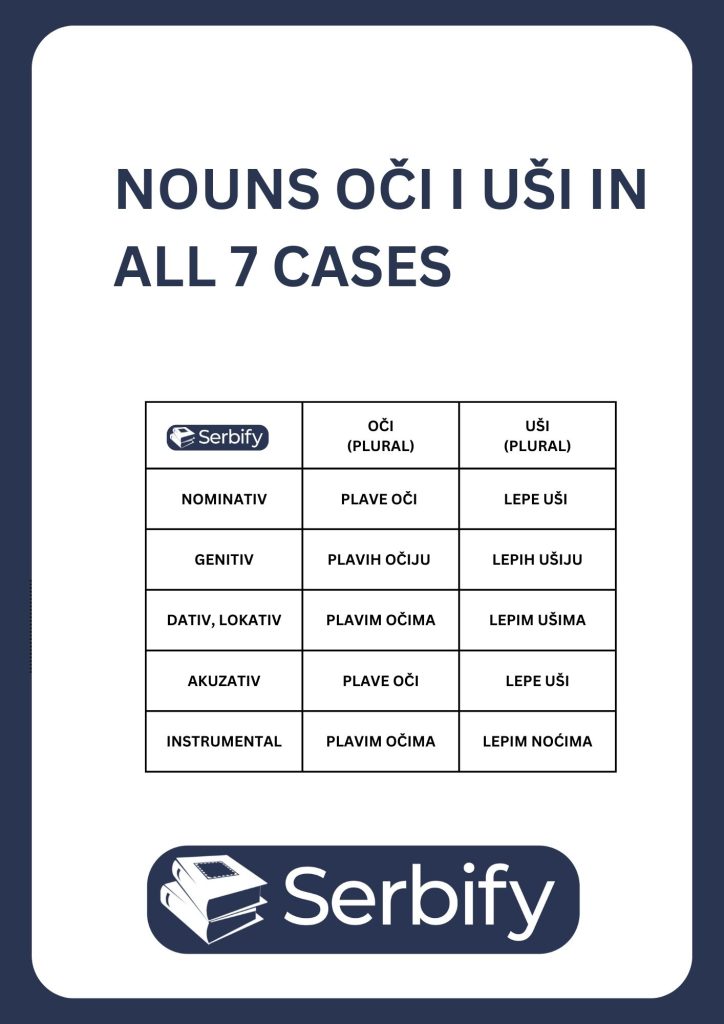
Exceptionality of this group can be also noticed if you look at genitive plural of the nouns above: the ending will be -IJU, which we can see only with several nouns in Serbian language: prstiju, gostiju, očiju, ušiju, kostiju.
Hope you find my explanation useful. If you are interested in my classes, please use the link below: https://serbify.com/
Free exercise with solutions: Let’s master feminine gender ending in consonant in Serbian language :
- _________________ je pratila sve što se u sobi dešava. (lepe, plave oči)
- Zbog _______________ često radimo nešto neobično. (velika ljubav)
- Zbog _______________ ljudi ponekad idu na proteste. (aktuelna vlast)
- Da li ste razgovarali o _______________? (misteriozna nova bolest)
- Videli smo na __________________ da ljudi u celoj zemlji imaju problema sa vodom. (današnje vesti)
- Da li postoji ____________ ? (lepa smrt)
- Krajem leta ima mnogo _____________ na sniženju. (lepe stvari)
- Kad imate mnogo _______________, možete se lako istresirati. (negativne misli)
- Zemlje Zapadne Evrope imaju mnogo ___________________. (ekonomske mogućnosti)
- U novoj zemlji se možemo lakše snaći uz _____________________. (adekvatna pomoć)
- Sa _______________ ne bih mislila kao tada. (ova pamet)
- Uvek se rado sećamo _________________. (svoja mladost)
- Koliko ljudi nema planove za __________. (starost)
- Mnogo ______________ ne deli činjenice iz svog privatnog života. (poznate ličnosti)
- Da li ________ uvek zna kvalitet vode? (javnost)
- Naš profesor je pravi stručnjak u ____________. (svoja oblast)
- Sa koliko godina kažemo da je čovek dostigao _________? (zrelost)
- Mnogo novih država želi da ima ________________. (puna nezavisnost)
- Hvala ti na ____________. (fleksibilnost)
- RIK mora da pronađe ________________ koje su se desile na izborima. (sve nepravilnosti)
Solutions: 1. lepim, plavim očima; 2. velike ljubavi; 3.aktuelne vlasti; 4. misterioznoj novoj bolesti; 5. današnjim vestima; 6. lepa smrt; 7. lepih stvari; 8. negativnih misli; 9. ekonomskih mogućnosti; 10. adekvatnu pomoć; 11. ovom pameti; 12. svoje mladosti; 13. starost; 14. poznatih ličnosti; 15. javnost; 16. svojoj oblasti; 17. zrelost; 18. punu nezavisnost. 19. fleksibilnosti. 20. sve nepravilnosti;


0 Comments