



Level: A2 to B2 (beginner to intermediate);
Where is the confusion with doneti and dovesti from?
So, if you look at the question:
Da li sam ja doneo ili doveo svoju kucu sa sobom?
In English, both sentences translate similarly: “Did I bring or bring my puppy with me?”
In some cases, Serbian makes fine distinctions that English does not. So, how do you know which one to choose? Is doneti connected with inanimate objects, and dovesti with living beings?
Is doneti conneceted with objects and dovesti with living beings?
The short answer would be – yes! We generally use doneti with objects and dovesti with living beings when they are used in the meaning to bring sth/smb to some place, which is common for both of them. Let’s make this simple with the examples:
Ex. Doneo nam je kolače za rođendan. (He brought us cookies for birthday.)
Doveo je svog psa u park. (He brought his dog into the park.)
Ona je donela knjige u biblioteku. (She brought books to the library.)
Gde si dovela goste iz inostranstva? (Where did you bring your guests from abroad?)
Donela sam vam slike iz Amerike! (I brought you photos from U.S.)
Ona nam uvek donosi mnogo poklona sa putovanja. (She always brings us many presents from the trips.)
Gde god da ide, ona dovede svog psa. (Wherever she goes, she takes her dog with her.)
Dovodila je uvek i svog sina na naša druženja. (She would always bring her son to our gatherings)
Note: We can have some additional meanings of those verbs which we are not going to discuss in this post.
While the statement above holds true for the majority of cases, it is not entirely accurate. Let’s see how this simple distinction becomes interesting.
The Nuance: The “Carrier” Rule for Pets 🐾
While the general rule holds true most of the time, Serbian grammar gets interesting when we look at exceptions.
Consider this sentence:
Ona je donela svoju kucu na Trg.
Why use donela (an object verb) for a puppy?
The rule comes down to how the animal moves:
- Use DOVESTI (dovedem): If the animal can walk alongside you, guided or moving freely on a leash.
- Use DONETI (donesem): If you are transporting the animal inside a carrier, crate, backpack, or bag. Serbian categorizes the overall unit as a carried object!
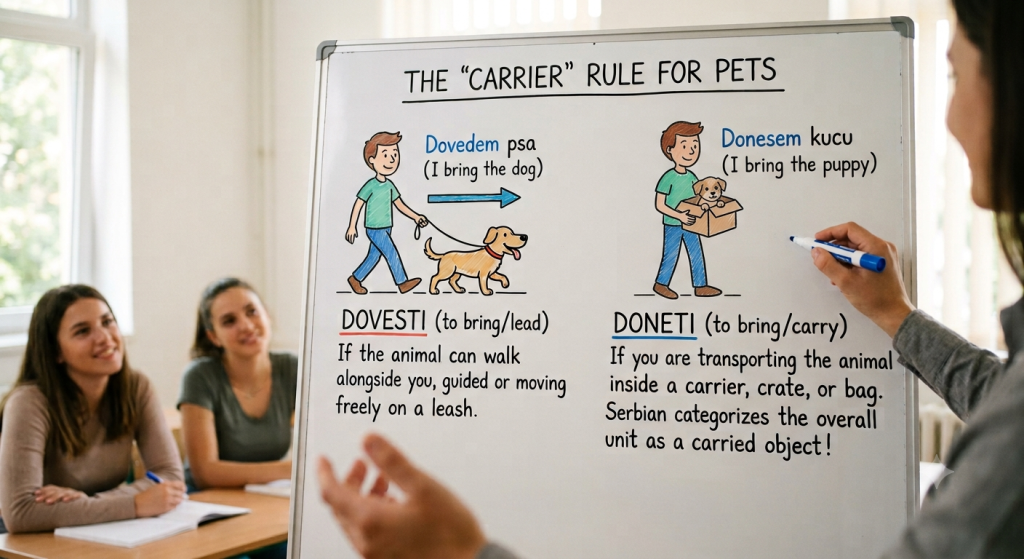
💡 What about human babies – da li donesem ili dovedem bebu?
When talking about humans, we always use dovesti, regardless of whether they can walk yet:
Svako je doveo svoje dete na plivanje.
Ona je dovela svoju jednomesečnu bebu u kafić. (Even though a 1-month-old baby can’t walk, we still use dovesti).
What is the difference between doneti and odneti or dovesti and odvesti?
Now, Let’s Flip the Direction: Odneti vs. Odvesti
Good news—once you understand doneti and dovesti, learning odneti and odvesti is effortless! They follow the exact same logic, but in the opposite direction.
While doneti and dovesti mean bringing something here, odneti and odvesti mean taking something away:
Odvesti = Taking a person or animal away
Odneti = Taking an object away.
Examples:
Naš pas je opet negde odneo moje papuče! (Our dog took my slippers away again!)
Naše želje nas obično odvode iz ove zemlje. (Our wishes often take us away from this country.)
The forms in infinitive, the present tense and participle active of the verbs: doneti, donositi, odneti, odnositi, dovesti, dovoditi, odvesti, odvoditi:
| the infinitive | the present tense | active participle | the translation to English |
| doneti | donesem | doneo, -la, -lo, -li, -le, -la | To bring (an object) |
| donositi | donosim | donosio, -la, -lo, -li, -le, -la | To be bringing |
| odneti | odnesem | odneo, -la, -o, -li, -le, la | To take away (an object) |
| odnositi | odnosim | odnosio, -la, -lo, -li, -le, -la | To be taking away |
| dovesti | dovedem | doveo, -la, -lo, -li, -le, -la | To bring (a person/animal) |
| dovoditi | dovodim | dovodio, -la, -lo, -li, -le, -la | To be bringing (person) |
| odvesti | odvedem | odveo, -la, -lo, -li, -le, -la | To take away (person/animal) |
| odvoditi | odvodim | odvodio, -la, -lo, -li, -le, -la | To be taking away (person) |
Free exercise:
Zadatak: Upotrebite doneti/donositi ili dovesti/dovoditi u pravom obliku u sledećim rečenicama:
- On uvek __________ mnogo prijatelja u kuću.
- Ko nam je ____________ ove kolače?
- Ona je ________________ dete kod nas juče i još nije došla da ga uzme.
- Naši rođaci uvek ____________ mnogo poklona iz inostranstva.
- _____________ sam nam nešto!
- Nisam često _______________ decu kod babe i dede.
- Kad je mi _____________ ovde, uvek je mnogo mirna.
- Jeste li kod kuće? ______________ vam nešto divno!
Upotrebite odneti/odnositi ili odvesti/odvoditi u pravom obliku u sledećim rečenicama:
- Kada si im ___________ ona dokumenta?
- Svako jutro ___________svoju ćerku u vrtić.
- Sav otpad ____________ u centar za reciklažu.
- __________ sam juče psa kod veterinara.
- Ako je ne _____________ danas kod drugarice, naljutiće se.
- Lako ću ih ____________ u park da se igraju, to je bar ispred zgrade.
- Sledeće nedelje ću __________ sve stvari koje mi više ne trebaju.
- On joj uvek _____________ lep buket ruža za rođendan.
Answers: dovodi, doneo, dovela/doveo, donose, donela/doneo, dovodila, dovedemo, donela/doneo, odneo/odnela, odovodim/-iš, -i…, odnosim/-i i sl., odveo/odvela, odvedem, odvesti, odneti, odnosi; Try without looking firstly!




0 Comments