


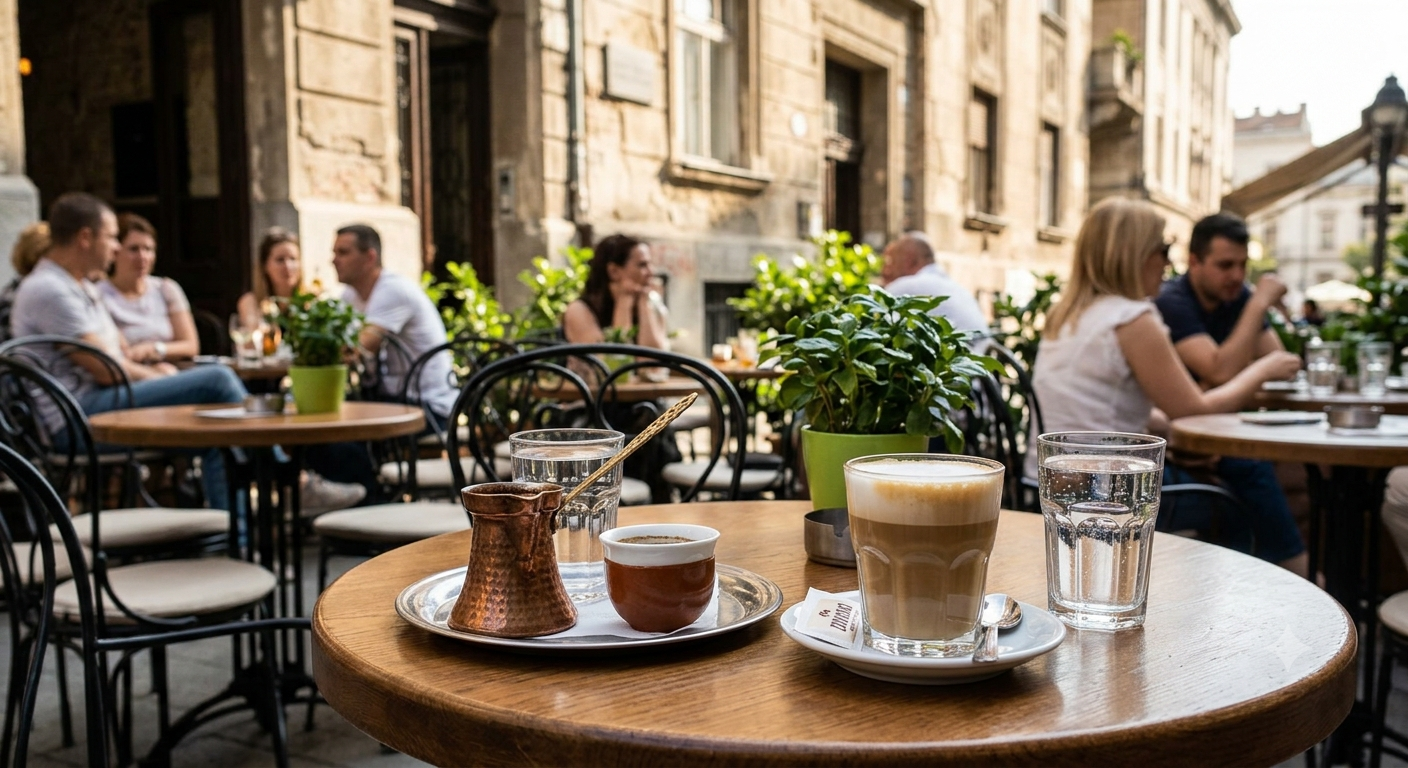
Coffee in Serbia
If there’s anyone who loves drinking coffee, it’s me!
I drink it in almost every variation: homemade coffee (domaća kafa) prepared at home (this is my favorite drink when I’m with my mom and sisters), espresso with extra water (produženi espreso), espresso with extra water and milk (produženi espreso sa mlekom), cappuccino (when it’s on promo with a slice of cake), cortado, macchiato… Among all these new popular types of coffee, tmy favorite is — flat white, which they make particularly well in specialty coffee shops.
What is a Serbian Café?
When we say kafić (café), we automatically picture those crowded outdoor seating areas (bašte) where people sip coffee, juice, or maybe even a glass of rakija in the morning. Later, in the afternoon, you’ll see them packed with people who, alongside coffee or juice, might have an alcoholic drink like beer or wine, while the evening is reserved for various alcoholic beverages and soft drinks. However, coffee is still served, of course, although not many people will dare to drink it late at night.
Waiter Politeness in Serbia
Unfortunately, I have to admit we don’t always have waiters we can boast about. Sometimes the service is truly wonderful, and other times you sincerely wonder what you did to the person for them to treat you that way. Most importantly, tipping is expected, and the average amount is about 10% of your bill. On the other hand, if you are extremely satisfied, you can leave more, and if you aren’t satisfied, you don’t have to leave anything at all.
Typical Serbian Café Dialogue: Waiter & Guest
Waiter: Dobar dan. Izvolite! (Good day. How can I help you? / Yes, please?)
Guest: Dobar dan. Za mene jedan produženi espreso sa mlekom i jedna kisela voda. (Good day. For me, one espresso with extra water and milk, and one sparkling water.)
Waiter: Dogovoreno. Da li želite i kolač sa voćem, imamo akciju danas? (Agreed / You got it. Would you also like a fruit cake? We have a special promotion today.)
Guest: Ne, hvala, samo kafa. (No, thank you, just the coffee.)
Waiter: U redu. (Alright.)
Waiter: Izvolite. (Here you go.)
Guest: Hvala. (Thank you.)
Waiter: Uživajte! (Enjoy!)
Guest: Hvala! (Thank you!)
Guest: Mogu li da platim? (Can I pay?)
Waiter: Naravno. Kako plaćate? (Of course. How are you paying?)
Guest: Karticom. (By card.)
Waiter: Samo trenutak, da donesem aparat. (Just a moment, let me get the card terminal.)
(…) Izvolite! (gives the terminal to tap the card, or asks for the PIN)
Guest: Izvolite nešto za vas. (Here is something for you. – hands over a banknote they deem appropriate for a tip)
Waiter: Hvala puno. Vidimo se! (Thank you very much. See you!)
Guest: Hvala vama! Prijatno. (Thank you! Have a nice day/goodbye.)
Essential Vocabulary for Getting By in a Café
In the meanwhile, the vocabulary you will need here isn’t huge, but it is very important to distinguish a few key things:
kartica, ž.r. – a card;
gotovina, ž.r. – cash money, but it is a bit formal, and not all the waiters will use it;
keš, m.r. – a very common colloquial Serbian word for cash;
Može li čaša vode za mene, molim vas? – May I get a glass of water, please?
Izvinite, gde je toalet? – Excuse me, where is the toilet?
Za ovde ili za poneti? – For here or to go?
Izvinite, šta je šifra za vaj-faj? – Could I get the Wi-Fi password?
Može li kafa bez kofeina? – Can I get a decaf /decaffeinated version??
Može li kafa sa biljnim mlekom? – Can I get a coffee with plant-based milk?
Tricks in Serbian Cafe That Will Make Ordering Much Easier:
Trick No. 1: Za Mene
Firstly, instead of saying “Ja bih jednu limunadu” (I would like a lemonade) or “Jednu limunadu, molim” (One lemonade, please) and thus complicating your life with the accusative case, I advise you to say “Za mene jedna limunada” (For me, a lemonade). This way, you only need to memorize one pronoun in the accusative (za mene), and then you simply add whatever you want in the nominative case.
For example:
- Za mene dupli espreso (For me, a double espresso)
- Za mene kolač sa kajsijom. (For me, apricot cake)
- Za mene domaća kafa. (For me, homemade coffee)
Trick No. 2: The magic word “Može”
Secondly, instead of struggling with complex verb forms, just use “Može” for almost everything. It simply means “Can I have…?” or “Is it possible…?” and sounds completely natural and local!
Može kafa? (Can I get a coffee?)
Može račun? (Can I get the bill?)
Može još jedna kisela? (Can I get another sparkling water?)
If you want an highly experienced teacher to learn and practice all the possible scenarios in Serbian with, feel free to contact me.

0 Comments