



Level: A2-C2
It may seem like we are going to delve into challenging intermediate or even advanced level problems, but based on my experience, there are many situations at the very beginning where many of my students would be thrilled to understand what is happening with this small word, its origin, form and meaning.
So, let’s start. Where does SE pronoun originate from?
SEBE (SE) is originally a reflexive pronoun that refers to any person: the reflexive pronoun named SEBE, SE is the same for all 6 persons and for all three genders, but has different forms in different cases. It got its name from accusative form:
We know now that SE comes from accusative, but let’s take a look and see how it looks in another cases:
| Nominative | / |
| Genitive | SEBE |
| Dative | SEBI |
| Accusative | SEBE, SE |
| Instrumental | SOBOM |
| Locative | SEBI |
Examples:
Genitive: SEBE:
- Ti od sebe mnogo tražiš. You ask a lot from yourself.
Dative: SEBI:
- Da li si ove cipele kupila sebi? Did you buy these shoes to yourself?
Accusative: SEBE, SE
- Svako jutro ljudi obično gledaju sebe u ogledalu. Every morning people usually look at themselves in the mirror.
- On se pogleda svako jutro u ogledalu. He looks at himself in the mirror every day.
Instrumental: SOBOM:
- Da li je ona zadovoljna sobom? Is she happy with herself?
Locative: SEBI:
- Ne volimo da mislimo o sebi. We don’t like to think about ourselves.
Find out how to decide whether you should use SE or not in your Serbian
The verbs that require SE are named povratni glagoli – reflexive verbs. This pronoun is the same used with all the persons. It is always written separately from the verb.
To “SE” or Not to “SE”? (The 2 Verb Types)
Verbs that require SE are called povratni glagoli (reflexive verbs). SE is always written as a separate word from the verb.
The biggest point of confusion for students is: Will SE always be used? Does the meaning change if I drop it?
The answer depends entirely on the type of reflexive verb you are using. Let’s break them down into two simple categories:
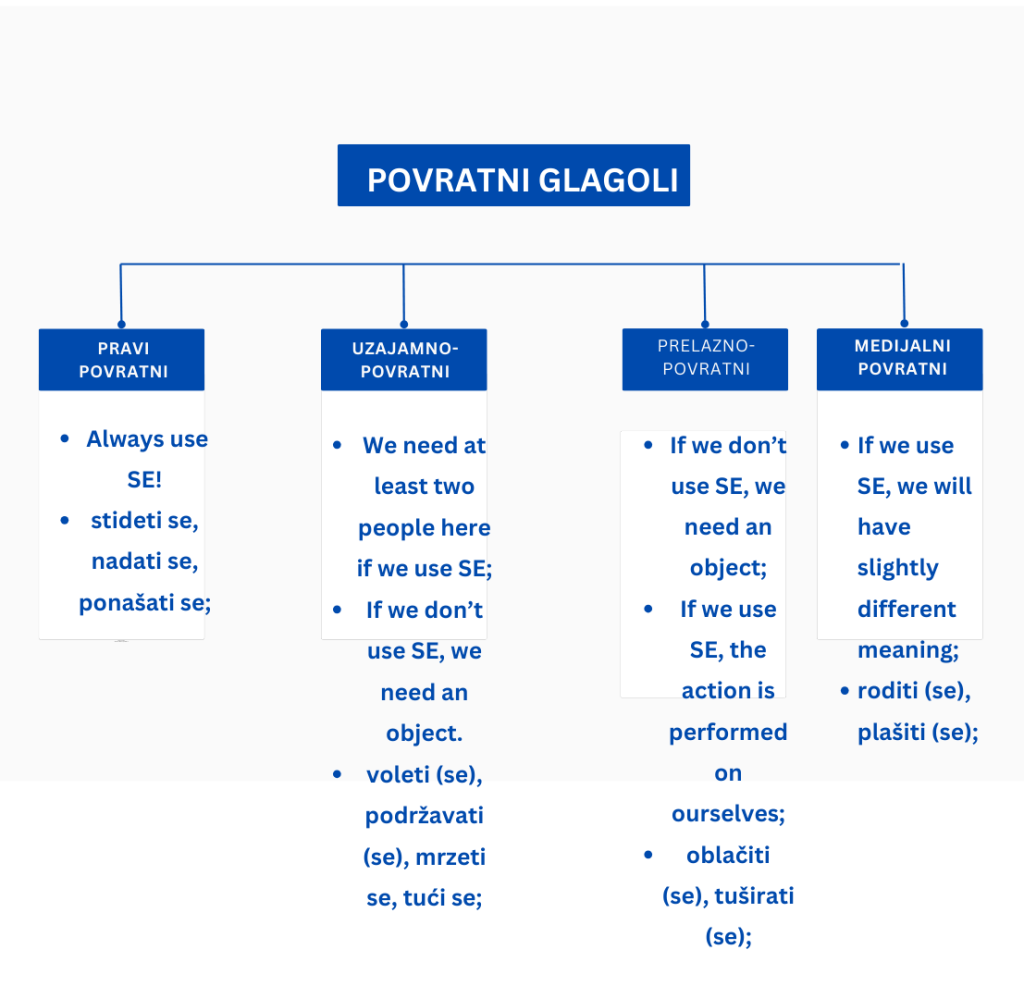
These are verbs that exclusively exist with the pronoun SE. If you remove it, the word is grammatically incorrect or meaningless.
Some verbs of feeling:
Nadam se lepom vremenu za vikend. (I hope to have nice weather for the weekend.)
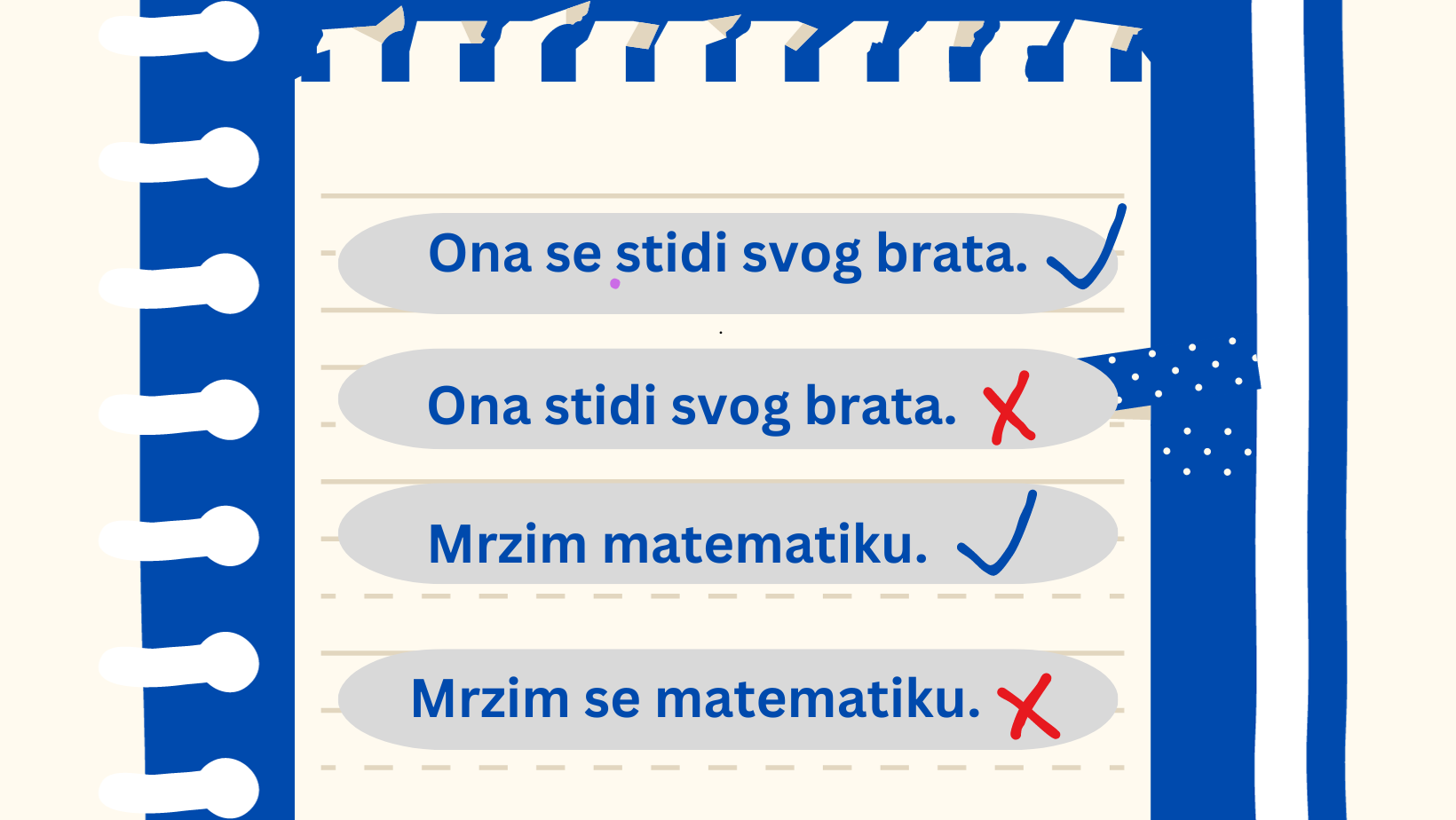
Da li se svi malo stidimo kad smo sa novim ljudima? (Are we all a bit ashamed when we are around new people?)
Some verbs of behavior/Interaction:
Vi ste se mnogo trudili da dođete na ovo mesto. (You put a lot of effort into getting to this position.)
Dve škole su se takmičile u matematici. (Two schools competed in mathematics.)
The “Satiety” Prefix (NA-): Prefixes with NA- show that an action was carried out to its absolute extreme or until fully satisfied.
Najela sam se mamine torte. (I am full from my mom’s cake.)
Neki studenti se napiju kad polože ispit. (Some students get drunk when they pass an exam.)
2. These verbs will have either slightly or not, but different meanings depending on whether SE is used or not:
Prelazno-refleksivni glagoli (Transitive-reflexive verbs): hey show as that the subject is performing action on themselves in case they use SE, but if they don’t use SE, they will require another object:
Oblačim se svako jutro za posao. I get dressed for the work every morning.
Oblačim decu svako jutro za vrtić. I dress the children every morning for kindergarten.
Tuširaju se na plaži posle svakog kupanja. They shower on the beach after every swim.
Juče sam tuširala svog psa u kadi. Yesterday I showered my dog in the bathtub.
Medijalni glagoli (Medial verbs): Can be used with or without SE, with a slight change of meaning. Those verbs will also, like previous, be transitive verbs if we omit SE, but the action does not happen to the subject itself and the action is not performed on the subject if we use SE. Examples:
Rodila sam se u malom gradu. I was born in a small town.
Juče je moja sestra rodila devojčicu. My sister gave a birth to a girl yesterday.
On se plašio da ide kod zubara kad je bio mali. He was afraid to visit his dentist when he was small.
Bake su nas plašile policijom kad smo bili mali. Our grannies used to scare us with the police when we were little.
Uzajamno-povratni glagoli (reciprocal): When SE is used, reciprocal verbs imply two or more subjects who perform an action on each other. When SE is not used, the verb becomes transitive as the ones in the first two groups :
Oni se mnogo vole. They love each other very much.
Ona mnogo voli svog psa. She likes her dog very much.
Ljudi se ponekad mrze. People sometimes hate each other.
Moja mačka mrzi mog psa. My cat hates my dog.
💡 Teacher’s Tip: When learning vocabulary, pay attention to brackets! If a verb can switch types, I will write it as tuširati (se). If SE is non-negotiable, I will write it without brackets: najesti se, stideti se.
What is the position of SE in the sentence? How does SE follow the word order?
Since we know that SE is actually form of the pronoun, we know that it is going to follow the word order that is typical for the shorten forms: It will always come right after the beginning of the clause and, if there are other pronouns, it will be at the very end of the enclitics line.
Example:
Ona se šeta svako jutro.
Nisam ga se najela kako sam htela. (kolača, p.a.)
Nije mu se dopao novi kompjuter.
Mi smo joj se divili kad smo videli njene radove.


0 Comments